
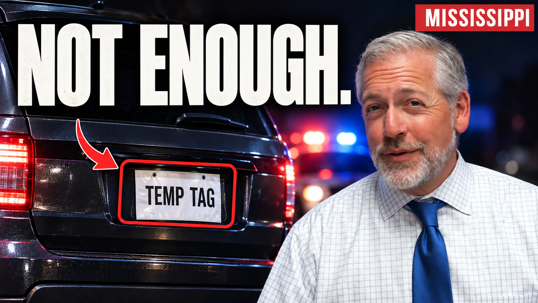
Can police pull you over just because your car has a temporary tag? In Wilson v. State, the Mississippi Court of Appeals held that a clearly displayed, readable temporary tag alone did not justify the stop. The officer had observed no traffic violation or other suspicious driving. In this video, Mississippi criminal-defense attorney Matt Eichelberger explains why that distinction mattered, why evidence discovered afterward could not justify the earlier stop, and how different facts can change the answer. Watch the full discussion below, or read the transcript.
Transcript
Can police pull you over just because your car has a temporary tag? The Mississippi Court of Appeals says that alone isn't enough, and in one particular case, that ruling overturned a 10-year prison sentence.
A couple of years ago, an officer was following a Ford Explorer on I-55 in north Mississippi. There was no speeding. There was no traffic violation at all. The temporary tag was, in fact, properly displayed and readable, but the officer stopped it anyway just because it had a temporary tag.
After the stop, the officer smelled marijuana. Police then searched the vehicle and found marijuana and a gun. Unfortunately for the passenger, Mr. Wilson, he was a convicted felon, and that meant that he later on was convicted of possessing a firearm as a convicted felon, and the trial court sentenced him to a decade to serve in the penitentiary.
But the appeals court ruled that the stop was unlawful. The resulting evidence then should have been suppressed by the trial court. With no remaining evidence to support the conviction, the court rendered a judgment of acquittal. What that means is it's over.
I'm Matt Eichelberger. Let's look at what made this stop unlawful and which facts could change the answer.
The detail that matters most is something the officer admitted in court. He could see the temporary tag. He could read it. It wasn't dirty or covered up, and he had followed this vehicle for more than a minute without seeing a traffic violation or any other suspicious driving. So why stop it?
The officer testified that the temporary tag couldn't be verified through his police department database. He wanted to check whether the vehicle was stolen and whether the occupants were complying with the state's registration laws. He hadn't actually tried to verify this particular tag before making the stop. He just saw a temporary tag and decided to stop the vehicle. His position was that having a temporary tag gave him a basis to pull the vehicle over and investigate further.
Now, think about what that would mean for somebody who just bought a car. Even with the tag properly displayed, and even while driving normally, that person could be stopped simply because the permanent plate hadn't arrived yet. The Court of Appeals rejected that reasoning.
The legal standard here is called reasonable suspicion. An officer has to have specific facts that reasonably suggest a legal violation or criminal activity is going on. The officer doesn't have to prove a crime before making an investigative stop, and the officer doesn't always have to personally witness a traffic violation, but there has to be a reason tied to this vehicle or its occupants.
The general concern that a temporary tag might be invalid doesn't tell you what's wrong with that particular tag. The officer's testimony left that question unanswered.
The court then applied both the Fourth Amendment and a portion of the Mississippi Constitution called Article 3, Section 23 that is broader than the Fourth Amendment, and its conclusion was that the temporary tag, standing alone, did not justify the stop. The last two words matter, standing alone.
This decision does not mean that every vehicle with a temporary tag is immune from being pulled over, far from it. Now, suppose an officer has a lawful basis to stop you for speeding. Having a temporary tag doesn't erase that basis. Or let's say the temporary tag isn't properly displayed, or the officer has specific facts suggesting it is invalid for some reason. That's a different question.
The court discussed earlier cases involving tags that officers said they couldn't see. In one, the rear window was so heavily tinted that the officer couldn't see the temporary tag through it. Now, that matters because the officer was investigating what appeared to be a missing tag in that case.
Here, the officer admitted the tag was visible and readable. There was no evidence that it was displayed unlawfully or that it was somehow obscured. So the question isn't simply whether the car had a paper tag. The question is what facts gave the officer a lawful reason to stop that car?
And even when the stop is justified, the officer's later actions still have to comply with the law. A lawful traffic stop isn't automatic permission to search everything in a vehicle.
Now, the part that can feel counterintuitive, the police really did find marijuana and a gun. Why didn't that save the case? Look at the order of events.
First, the officer stopped the vehicle. That's first. Then as he approached it, he smelled marijuana. Then came the searches. Marijuana was found in the glove compartment. A handgun was found between the front passenger seat and the center console next to where Mr. Wilson had been sitting.
The officer hadn't smelled the marijuana when he decided to stop the car, and he hadn't found the gun. The first decision was to stop the car. Those later discoveries can't then supply the reasonable suspicion to justify the stop. That reasonable suspicion was missing at the beginning.
Otherwise, an officer could stop a car without a lawful reason, search it, and use whatever turned up to justify having stopped it in the first place. That ain't how it works in America.
In this case, the Court of Appeals held that all of the evidence against Wilson resulted from the stop, which was unlawful and should have been suppressed. Suppressed means the prosecution can't use that evidence against the defendant.
The court's analysis covered all the evidence against Wilson here. Other cases can involve exceptions or evidence obtained independently, but in Wilson, there was nothing left to support that conviction.
That is why the court went beyond ordering a new trial. That's the normal course of action. When a court decides that there was an error at the lower court, they'll send it back for a new trial. But here, the Court of Appeals reversed the conviction and rendered a judgment of acquittal.
The 10-year sentence, which had been imposed without eligibility for parole, was overturned and erased.
And there's one distinction I want to make clear. Wilson also challenged whether the state had proved he possessed the gun. The driver testified that the gun belonged to her. Wilson denied owning it or possessing it, but the Court of Appeals did not decide his arguments about possession or constructive possession. It didn't need to reach them because the unlawful stop resolved the appeal completely.
So this opinion should not be read as saying that a passenger can never possess somebody else's gun, or that a gun near a passenger always proves possession. That's not what they found. The holding we're discussing is about the stop and whether the evidence came from it.
For drivers, the practical point is to keep your temporary tag properly displayed and readable, and keep the relevant purchase and registration paperwork.
If you believe a stop is unlawful, don't try to settle that dispute on the roadside. Stay calm and address the legal issue through the court. You don't hold court on the side of the road, okay?
If the stop leads to a criminal charge, the reason for the stop deserves a close look. What the officer actually observed before turning on the blue lights. What reason did the officer give? Does the video support that account? Was the tag visible? Was there another basis for the stop? You want to preserve any relevant footage and paperwork and make a note of what you remember while it's fresh.
The item that the police found may be what brought you to court, but the legal analysis can begin before they ever found it, right? You understand the timeline there?
In Wilson, that decision to pull the car over changed the entire outcome. Because there wasn't a reasonable basis to stop the car, the stop was violative of the Fourth Amendment and the Article 3, Section 23 provision of the Mississippi Constitution, and those have to be protected, and that's what the Court of Appeals did here.
I'm Matt Eichelberger with Eichelberger Law Firm. If you're facing a criminal charge in Mississippi, contact our office to discuss the facts of your case. And to subscribe for more explanations of criminal law in Mississippi and decisions that affect your rights, you know what to do.
Read the case
Wilson v. State, 429 So. 3d 944 (Miss. Ct. App. Feb. 17, 2026), No. 2024-KA-00632-COA.
The featured image is an editorial illustration, not a photograph of the Wilson stop. The bodycam excerpt depicts a separate Florida incident, identified on screen. Footage sources and credits are in the YouTube description.
This video provides general legal information, not advice about an individual case. Watching it does not create an attorney-client relationship. Outcomes depend on the facts and applicable law.